


I suspect this happens with many disease-related patient interest organizations... you work hard to accomplish your mission of educating, supporting and advocating all year long, but there comes a moment in the year when attention is focused on your group like a laser beam. The spotlight, if you can manage to grab it, falls on you, your organization and your disease. It is your chance to do something more, something, hopefully, that will carry you to a new plateau in the coming year.
There had been three "National Sleep Apnea Awareness Day" events prior to my becoming the executive director. It was skipped the year I came onboard, the time for it had past by the time I got there and my predecessor was already focusing on her new job and only serving in a caretaking role at the ASAA until her replacement could be found.
Last year, in addition to collaborating with the National Sleep Foundation and having Sleep Apnea Awareness Day be "during National Sleep Awareness Week" (which it had been in prior years, but not designated so - witness the term "National" in the earlier iterations) we did something different - we had a public event - a lecture, which was co-sponsored by the American College of Chest Physicians - Sleep Institute. I had worked on similar events in the past, but this one was the first where I was in charge - heady stuff and plenty of opportunities to make mistakes. The intention of the lecture was to bring together patients, physicians, folks from Congress, Washington association folks and sleep industry representatives to listen and talk together about sleep apnea in the hopes of raising the visibility of the condition to the level it deserves.
SAAD 2005 and the lecture came off well... the targets I had set were ambitious and we did not reach all of them, but, I and others were happy with the results nonethless. The speaker for the lecture was Dr. David Rapoport, who was brilliant and provided a wonderful overiew of the sleep apnea - its pathophysiology, the implications of untreated disease and the treatments available. We also had, as an unexpected guest - Peter Farrell of ResMed Corporation who added his own particular brand of enthusiasm to the proceedings.
One of the unintended results of the lecture was that Apnea Support Forum was born from conversations that followed with Mike Sussman and Linda Druyer who both attended the lecture. There is a lot to say about the forum and at some future date I will, but not today.


March 12, 2006
Pediatric Sleep Medicine Conference (Part 2)
The second day of conference began with inspirational words from Barbara Phillips, MD MPH. She is well known in the sleep community for her forthright positions on many issues. While her presentation did not speak directly to issues concerning sleep, she was providing encouragement to the group of pediatric sleep specialists gathered in the room and thinking about the future direction this group should take in their efforts to promote pediatric sleep medicine.

The second session was devoted to a working group on the treatment of sleep disordered breathing - OSA and primary snoring. The leader of the session was Dr. Christian Guilleminault from Stanford University(pictured above). Dr. G has a spot in the pantheon of physicians and researchers in the field of sleep medicine. His background is psychiatry and not pulmonology like many of other specialists in sleep.
This discussion got off to a fast start. Dr. G asked where should the clinical examination of a child suspected of sleep disordered breathing (SDB) begin. Clearly it is in the upper airway, but for him the upper airway begins at the tip of the nose. Before looking at the tonsils, when considering children one must look to see if there are any malformations of the nasal opening. Another area to consider when examming a child suspect of SDB, which for him includes snoring, is the roof of the mouth. How the hard palate is shaped can have an impact on the breathing of the child. And SDB can have an impact on the how the face of the child grows.
The session lasted an hour and 45 minutes and Dr. G challenged some of the ideas of those assembled in the working group. Time flew past and at the end four recommendations were reported out to the rest of the conference. How the group will act on these recommendations remains to be seen, but it was fascinating to listen to him and be offered a different perspective on treatment from the traditional first line treatment for SDB in children - Tonsillectomy and Adenoidectomy (T & A).
Here were the four recommendations - though not all were unanimous:
1. Every child presenting with symptoms of SDB should have a thorough clinical examination by a physician knowledgeable in sleep medicine.
2. Formal polysomnography should be used to quantify/assess severity in every child with symptoms suggestive of SDB.
3. Treatment considerations need both to extend beyond simply T & A and to include considerations as the most effective surgical approach if T & A is employed.
4. Follow up clinical evaluation and polysomnography should occur in every child after surgical intervention.
With that I close out on the Peds Sleep Med meeting... excited about collaborating on a new education bulletin for parents to have children who have sleep disordered breathing and sufficiently convinced that there is more to the treatment of sleep apnea in children than just the surgical option.
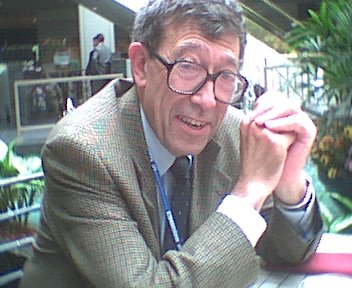
The second session was devoted to a working group on the treatment of sleep disordered breathing - OSA and primary snoring. The leader of the session was Dr. Christian Guilleminault from Stanford University(pictured above). Dr. G has a spot in the pantheon of physicians and researchers in the field of sleep medicine. His background is psychiatry and not pulmonology like many of other specialists in sleep.
This discussion got off to a fast start. Dr. G asked where should the clinical examination of a child suspected of sleep disordered breathing (SDB) begin. Clearly it is in the upper airway, but for him the upper airway begins at the tip of the nose. Before looking at the tonsils, when considering children one must look to see if there are any malformations of the nasal opening. Another area to consider when examming a child suspect of SDB, which for him includes snoring, is the roof of the mouth. How the hard palate is shaped can have an impact on the breathing of the child. And SDB can have an impact on the how the face of the child grows.
The session lasted an hour and 45 minutes and Dr. G challenged some of the ideas of those assembled in the working group. Time flew past and at the end four recommendations were reported out to the rest of the conference. How the group will act on these recommendations remains to be seen, but it was fascinating to listen to him and be offered a different perspective on treatment from the traditional first line treatment for SDB in children - Tonsillectomy and Adenoidectomy (T & A).
Here were the four recommendations - though not all were unanimous:
1. Every child presenting with symptoms of SDB should have a thorough clinical examination by a physician knowledgeable in sleep medicine.
2. Formal polysomnography should be used to quantify/assess severity in every child with symptoms suggestive of SDB.
3. Treatment considerations need both to extend beyond simply T & A and to include considerations as the most effective surgical approach if T & A is employed.
4. Follow up clinical evaluation and polysomnography should occur in every child after surgical intervention.
With that I close out on the Peds Sleep Med meeting... excited about collaborating on a new education bulletin for parents to have children who have sleep disordered breathing and sufficiently convinced that there is more to the treatment of sleep apnea in children than just the surgical option.
Subscribe to:
Posts (Atom)