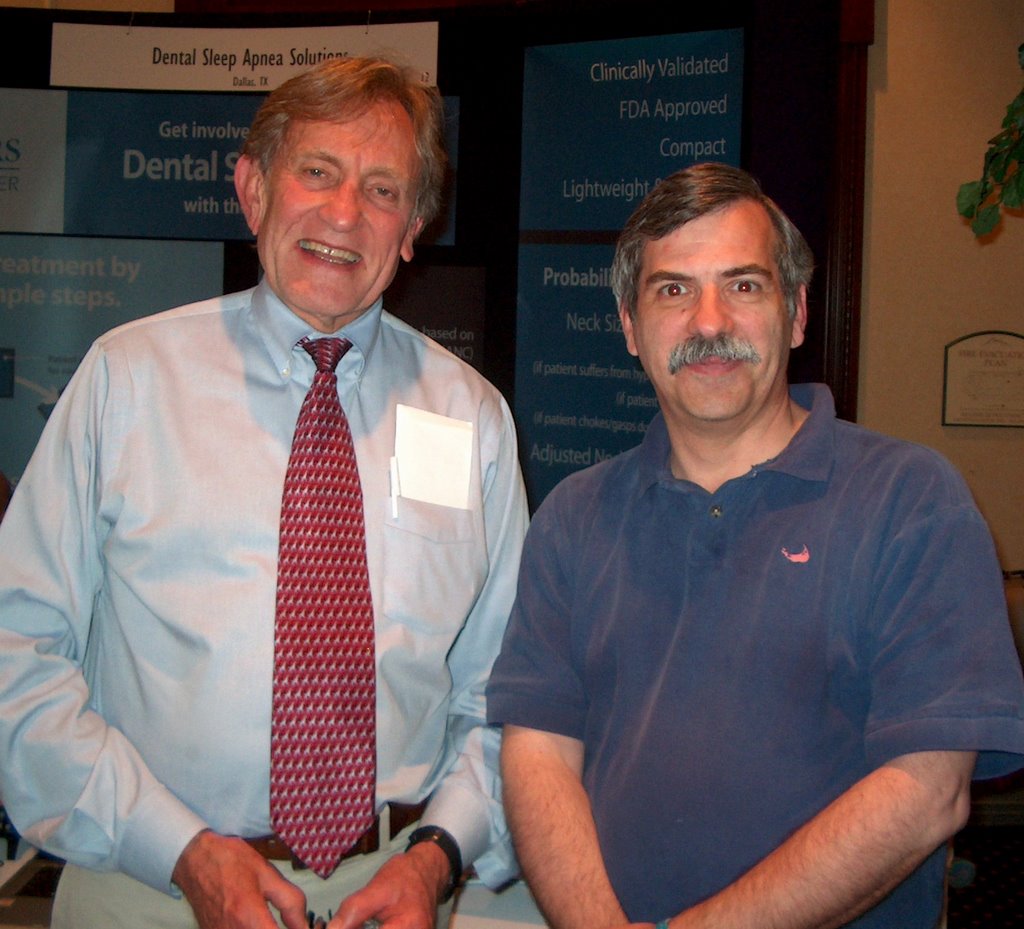
There was an excellent review of sleep disorders and how oral applicances are a treatment option for some sleep apnea suffers. What followed the overview were three presentations - one on sleep apnea and metabolic syndrome, sleep apnea and cardiovascular disease and sleep apnea and oxidative stress and inflammation.
The case for a relation between sleep apnea and metabolic syndrome has always been clear un my mind. But in the first presentation, Naresh Punjabi, M.D., Ph.D. from Johns Hopkins established rather persuasively that OSA and metabolic syndrome are linked through a condition that develops in people with both conditions - obesity.
The second presentation was offered by Dr. John W. Shepard, Jr. of the Mayo Clinic. He began talking about breathing and the problems caused to the heart
 by the cessations in breathing that occur during apneas. He presented through numerous diagrams and charts that described the acute cardiovascular responses to asphyxia (which is what happens, for some, countless times during the night. He closed his presentation with the Ode to the Pickwickian (an allusion to the Dicken's novel the Pickwick Papers where a character with a form of sleep apnea was first described).
Th
 e third presentation in this series was from Virend Somers... who I had met while in Detroit earlier in the year. His presentation took the discussion to a whole different level... the molecular level. There are three actors in his drama - Adioponectin, C-reactive_protein (CRP)and Leptin. The stage where this drama is played out is in the Endothelium. Without going into a lot of detail... which is more than I can do. CRP had been shown to be a mediator of heart disease and sleep deprivation increases the amount of CRP in the blood stream. More CRP... more heart disease.
The keynote address was delivered by Dr. Remmers and his presentation was an exhordation the sleep dentists assembled to do more to recognize and treat sleep apnea. He used the series of slides showing the increase in obesity in the United States from 1990... it is frightening! As he was speaking I thought to myself... I should comment on the Institute of Medicine (IOM) report about the need changes in diagnostic technology. And as if he was reading my mind he mentioned the IOM report. Nothing like having your sentences finished by someone you admire.
I can see why the sleep dentists made Dr. Remmers and honorary member of the Academy.
Next... onto the main event... Sleep 2006